First vs. Second Focal Plane Scopes Explained
If you’re shopping for a variable glass optic – a typical rifle scope
– then chances are, you’ve come across acronyms like “SFP”, which means
“second focal plane,” and “FFP”, or “first focal plane.” But whare
first and second focal planes? And which type of scope should you buy?
What is an SFP scope?
A
SFP scope uses a reticle that’s etched into the second focal plane
aperture. The reticle remains full-sized regardless of magnification.
That means if you buy, say, a Bushnell AR Optics 1-to-4x scope, the reticle doesn’t get larger or smaller as you increase or decrease magnification between 1x and 4x.
Why use an SFP scope?
For
most shooters, using a reticle that varies in size with magnification
would be an inconvenience not worth the advantage an FFP reticle
provides, which we’ll discuss next. Using a fixed reticle means that an
easy, clear sight picture is obtained at any magnification.
Many SFP reticles — like the one found in the Bushnell AR scope, pictured above — provide dots or hash marks measured in MOA or MILs.
These markings allow a shooter to make holdover adjustments for windage
and distance. That means instead of using the scope’s turrets to
physically adjust the position of the reticle, a shooter can visually adjust for those same windage and distance factors without affecting their zero.
The disadvantage of an SFP reticle
Holdover
adjustments are easier and faster than turret adjustments, but they
only work well when an SFP reticle’s markings are used at a specific
magnification. For most SFP scopes, that’s full magnification. If one
reduces an SFP scope’s magnification by half, its MOA or MIL markings
can still be used by doubling the values used to calculate the
holdover.
For example, if a single marking in an SFP reticle
represents 1 MOA of measurement at 8x magnification, then that same
marking represents 2 MOA at 4x magnification. But making the same
mathematical conversion at, say, 2.2x or 3.8x magnification becomes
inconvenient, at best.
What’s an FFP scope?
An FFP scope’s
reticle is etched into the first focal plane aperture. That means the
size of the reticle (and the MOA or MIL markings) in an FFP scope gets
larger or smaller when magnification is increased or decreased.
The advantage of an FFP reticle
Because the dots and hash marks in an FFP reticle scale with magnification, they are always accurate at any magnification. That means a single MOA dot measures 1 MOA at 1x, 2.2x, 3.8x, 4x, 8x, and any magnification up to, and including, full power.

If
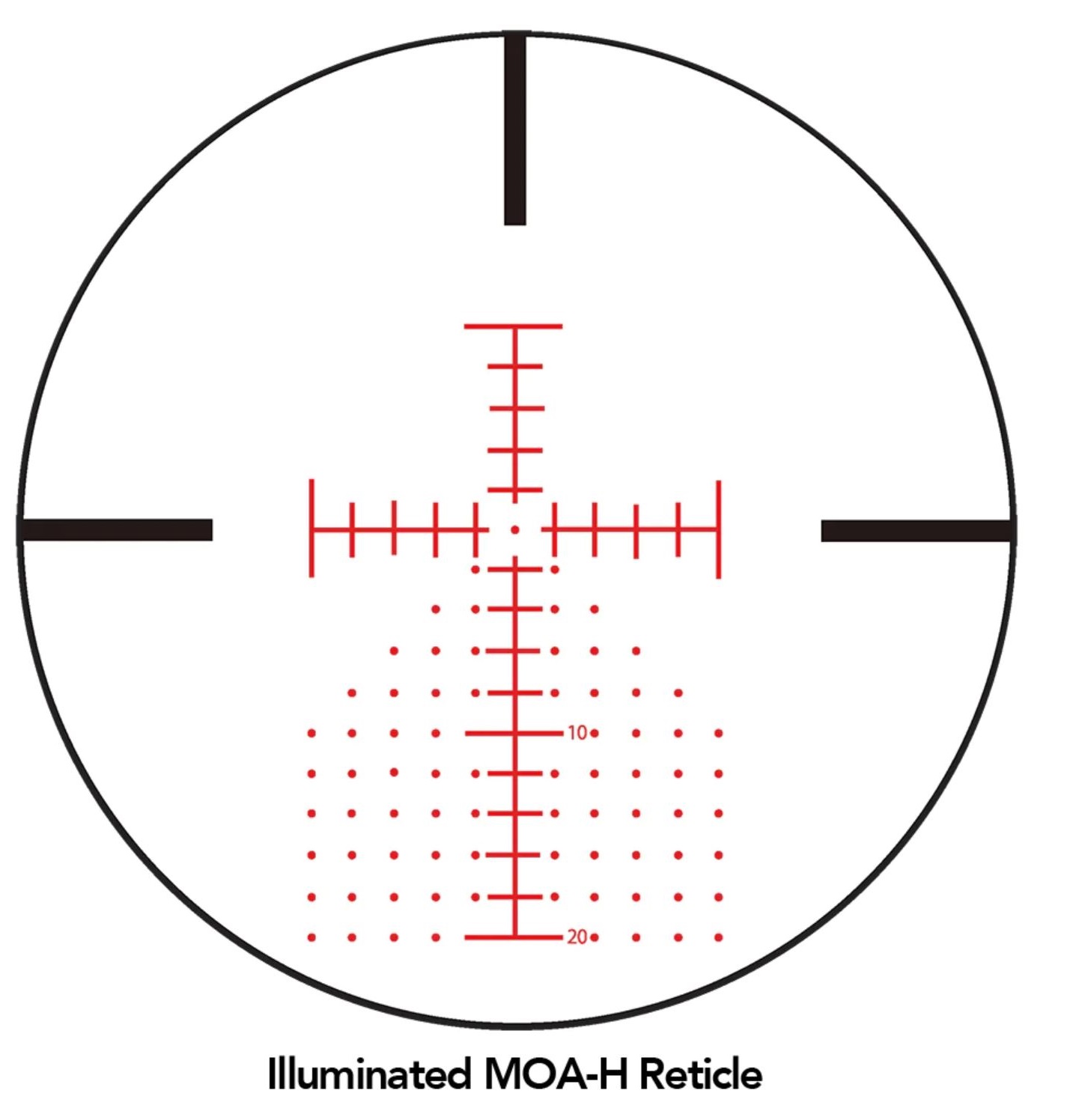
you’re using a reticle like the MOA-H Reticle found in a Sightron
scope, you can use precise holdovers at, say, 16x or 24x power. But FFP
scopes aren’t without their drawbacks, especially when it comes to using
a reticle filled with dots and marks, like the one above.
The drawback of an FFP reticle
While
an FFP reticle like the MOA-H is useful at high magnification, all
those individual dots become difficult to see at low
magnification. Shooters who use FFP reticles say this disadvantage is
mitigated by how an FFP scope should be used in the first place.
That’s
because FFP scopes are designed for accuracy at greater distances,
where high magnification and fine adjustments are required. For its
intended use, this type of reticle will typically appear large and clear
enough to use effectively.
Which is Better? SFP or FFP?
Although
first focal plane scopes provides a distinct advantage, many shooters
still prefer using a second focal plane scope. Unless you’re heavily
invested in competitive long-distance shooting and you require quick
holdover calculations at various magnification powers, you’ll probably
appreciate a fixed SFP reticle.
In fact, the shooter who wrote this guide chose a Sightron SIII with an SFP reticle
for his custom Savage .308. I’ve found that for most distances I shoot
at (which vary from 100 yards up to 700 yards or more), I tend to shoot
at full magnification, or 24x. This renders the argument between SFP and
FFP moot because my reticle’s markings are always mathematically
accurate.
When I can’t sight a close-range target at full
magnification, I simply dial down to half power (12x) and double the
calculation of each marking within my reticle. I find merely having to
double my holdover calculation by two is far more convenient than
dealing with a reticle that becomes twice as small at half power.