Slings, Sling Mounts, & Adapters Compared
Slings are often overlooked by new gun owners. But your rifle or
shotgun can benefit from a good sling, and not just when it comes to
carry or convenience. A proper rifle sling
can improve accuracy, providing you with a stabilizer that allows for
steadier aiming and better recoil control. These are called sling holds,
and we’ll cover them here. But first, let’s look at the types of slings
and their mounts and adapters.
Types of Slings
There are three types of rifle and shotgun slings: One-, two-, and
three-point slings. The points refer to how many connections your sling
has between its straps and your long gun. Let’s look at how each is set
up.
Single-Point sling
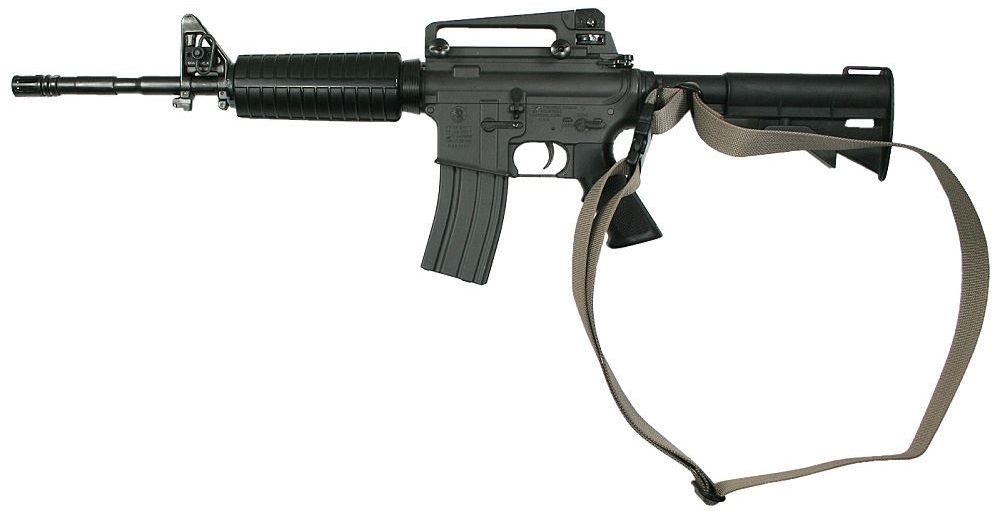
The single-point sling
provides the simplest setup and it’s arguably the most popular type of
sling for AR-15 owners. The one-point strap provides an easy, hands-free
way to carry your long gun. It’s typically favored by tactical rifle
owners, law enforcement, and military because it provides an easy and
quick transition to a shooting position with sights on your target.
Pros
The one-point sling is the easiest sling to carry. It can be draped
around the neck or slung over and under the shoulders, and it allows
your rifle or shotgun to remain slung directly in front of your chest
with the muzzle down. This is a safe and comfortable position to carry
your rifle if you’re often standing still and need to work with your
hands.
Cons
This sling setup isn’t as comfortable for long-distance carry,
especially if you’re trekking a relatively far distance on foot and you
prefer carrying your rifle without supporting it with your hands. For
that, we recommend a two-point sling.
Two-Point Sling
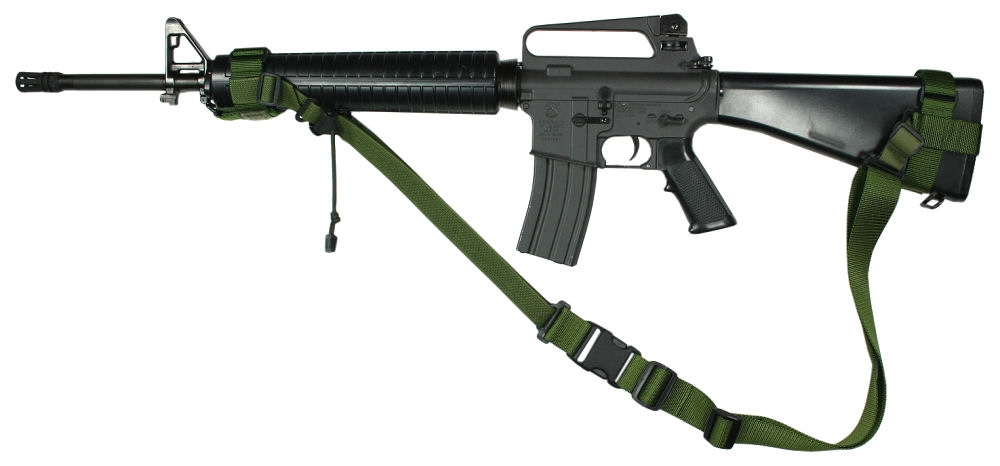
The two-point sling
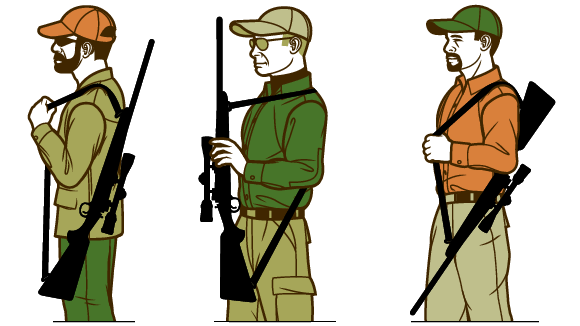
is the oldest and most popular setup, probably ever. It’s the most
versatile sling because it allows easy over-the-shoulder carry in
various styles, like the European, African, and American carry methods:
Pros
The two-point sling is also the easiest to put on and take off and,
unlike the one-point sling, this setup can be used to provide a
stabilizing hold on your rifle when you’re aiming and firing. This is
called a sling hold, which we’ll cover later.
Cons
The two-point sling provides a much longer strap than a one-point setup
and, compared to a one-pointer, it doesn’t provide as much free motion
when you’re trying to shoulder and fire your rifle while wearing the
strap.
Three-Point Slings

The three-point sling is a specialized setup that focuses mostly on the
carry aspect of a good rifle strap. Like the two-point sling, this
setup provides various carry positions but it focuses on rifle
orientation and different formations:
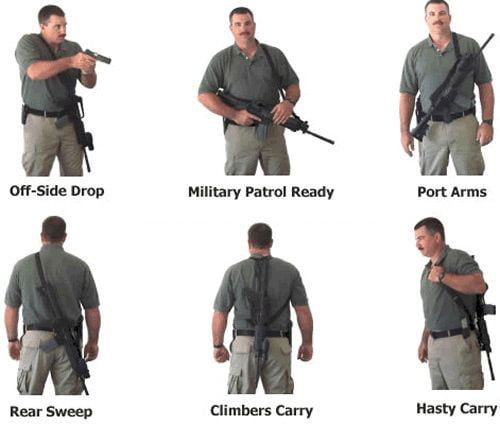
Pros
These carry methods provide a wide range of free motion while keeping
your rifle stabilized and tucked close to your person. This is an
especially convenient setup for climbers, hunters, and military and law
enforcement engaged in foot patrol or mounted operations. This setup can
provide adequate stability when firing from the hip or shoulder, using a
sling hold method.
Cons
Donning and doffing a three-point sling takes time. Getting this setup
sized correctly requires plenty of adjustment, too. If you’re in a hurry
and need to quickly ditch your straps, removing a three-point sling
might be difficult. This is especially true if you’re wearing plenty of
gear.
Types of Sling Mounts and Adapters
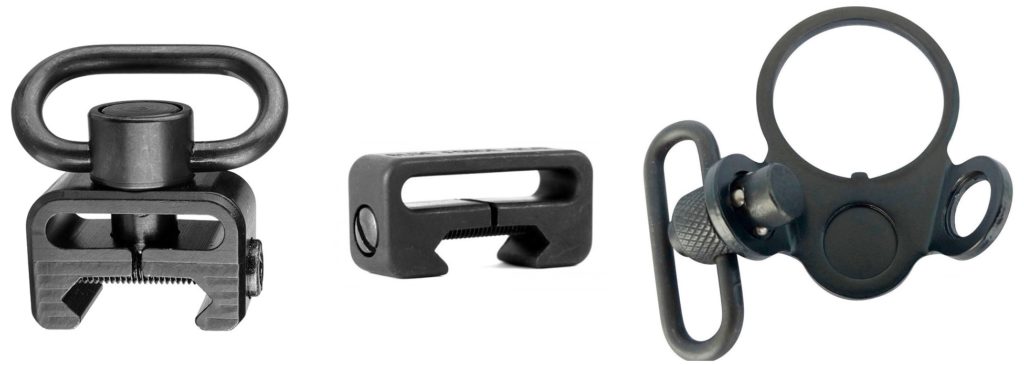
There are various types of mounts available for the average rifle
sling. Adapters are used to convert a sling from one mount type to
another. Adapters are also used to convert slings from one-, two-, or
three-point configurations to any other.
For most modern long guns, sling mounts are made to attach to standard
Picatinny/1913 or M-LOK rails, buttstocks, and receivers. Some sling
mounts don’t require rail attachments, since their attachment points can
often be found pre-fabricated on handguards and latch plates,
especially when it comes to the AR platform.
QD Swivel Mount
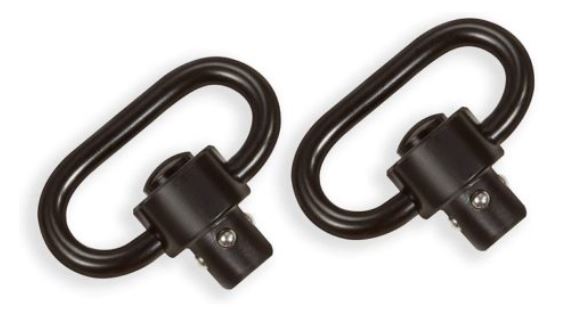
QD sling mounts,
or “Quick-Detach” mounts, are some of the most common sling mounts
you’ll find. Most modern handguards, latch plates, and buttstocks on the
AR platform come with pre-drilled QD stud mounting holes. That means
you don’t need to install anything extra to connect your sling.
These mounts are also the most convenient. To attach or detach a QD
stud, just depress the spring-loaded button atop the mount. This unlocks
the stud’s ball bearings, which clip inside the mounting hole. Swivel
studs are also popular because they can rotate freely within their
holes. This prevents your sling from twisting or wrapping itself up.
Locking Swivel Mounts
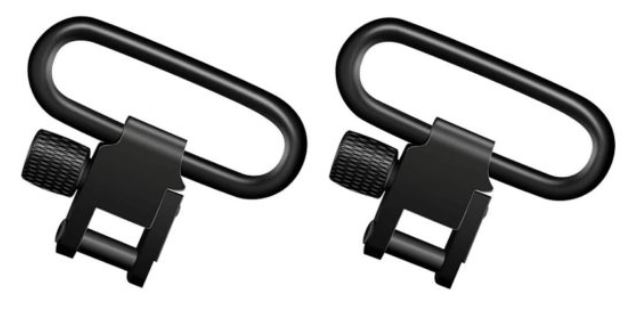
Quick-detach studs can be pulled free of their mounting holes with enough force. To prevent this, you can invest in locking swivel mounts
instead. These are threaded mounts that use small steel bars to connect
to stud holes mounted on your rifle. This studs cannot rotate freely in
their mounts, but they provide a locked mount in exchange for less
range of motion.
Clip and Hook Mounts
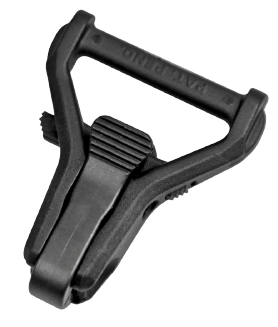
HK-style hook and Magpul Paraclip mounts
are quickly becoming the most popular sling attachments. They provide a
solid, locking connection to your rifle and they can rotate and swivel
more freely than locking studs. They can also be attached and detached
more quickly than a locking stud, but they don’t suffer from accidental
disconnects with excessive force, like QD studs.
Sling Latch Plates
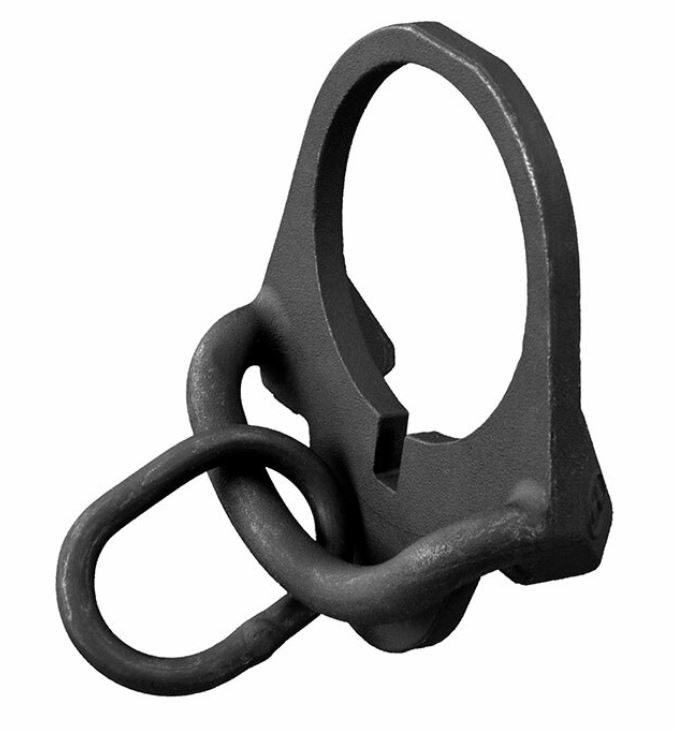
The sling mount latch plate
is one of the best places to mount your sling on your AR-type rifle or
pistol. This provides a natural point of contact that’s close to the
AR’s center of gravity. The latch plate mount is particularly effective
for hosting single-point slings. This setup allow your AR to hand right
down your chest with the buttstock conveniently located near your
shooting shoulder, and the handguard easily accessible at the waist.
Sling Adapters
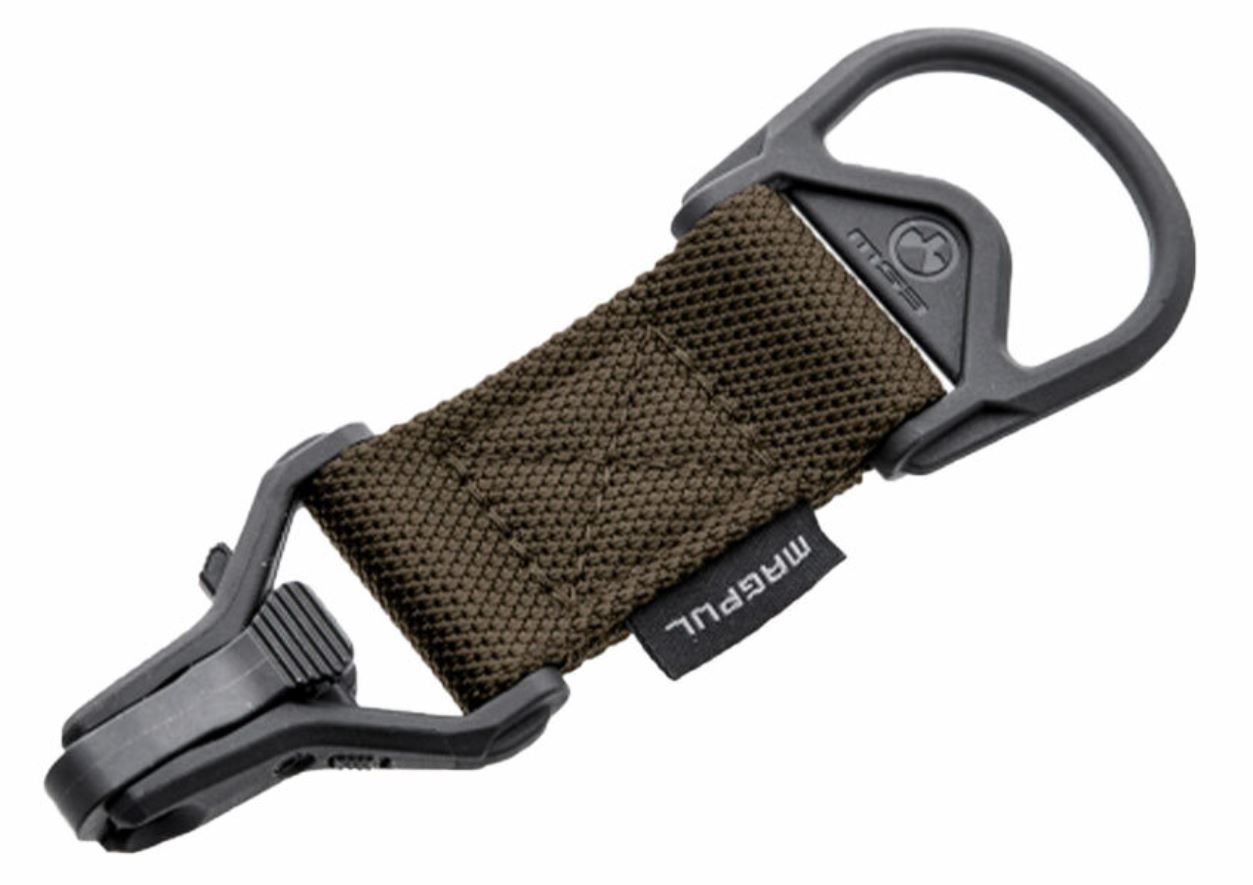
Sling adapters
allow you to convert a sling into a different configuration. Sling
adapters are little more than a sling mount with a small strip of ballistic nylon
and a loop on the other end, for attaching your sling’s original
mounts. With adapters like these, you can change how your sling attaches
to your rifle and you can swap your mount type without having to remove
your original mounts from your sling’s straps. Adapters like these can
be used to convert a one-, two-, or even three-point sling into any
other configuration.
Sling Materials
Sling material is just as important as the adapters and mounts you
choose. Some slings are made to be waterproof and rubberized for
all-weather shooting. Others have a bit of give, stretch, and padding to
make comfortable carrying easy over long distances. Many are made from
ballistic nylon, while others are cut from old-fashioned leather. Let’s
compare.
Ballistic Nylon/Cordura
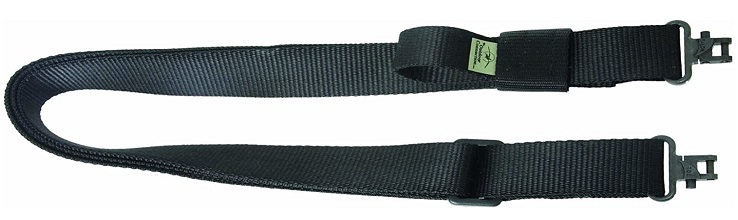
Ballistic nylon – often marketed by the brand name Cordura – is the
most popular sling material. It doesn’t stretch, warp, or easily twist
when hot, cold, or wet. It’s an incredibly tough material, capable of
holding hundreds of pounds of force. Nylon is also comfortable to carry,
providing a smooth fabric with piped edges that won’t chaff your skin.
Nylon also resists fraying and tearing when abused, and it can even be
used as a tourniquet in an emergency.
Bungee Cord
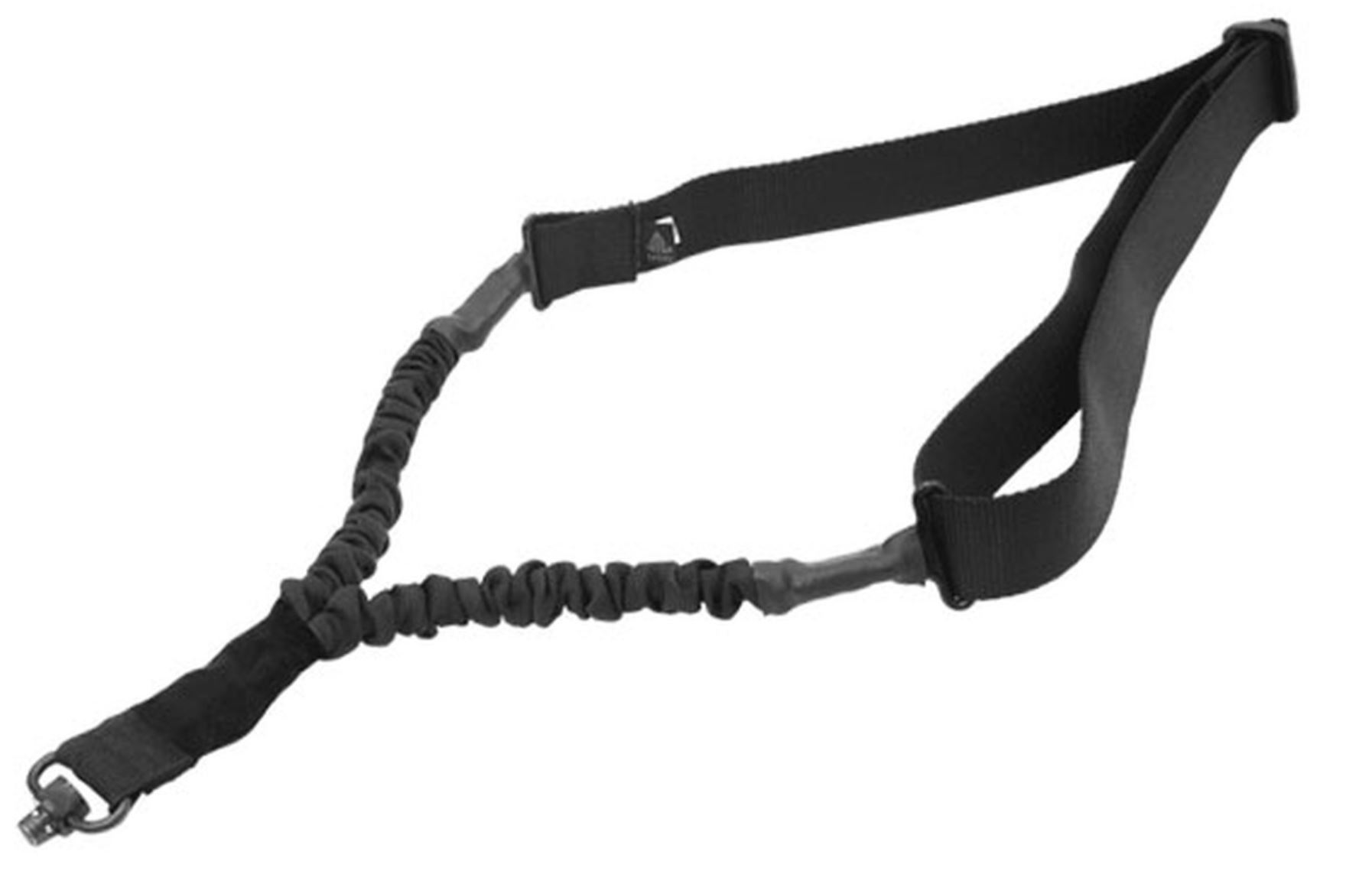
Many tactical slings, especially one-point slings, incorporate bungee
cord to provide a damping effect for your rifle. This helps prevent your
long gun from bouncing around when you’re on patrol or walking on foot,
and it can be used in tandem with a sling hold to greatly improve felt
recoil and muzzle control.
Neoprene/rubber

Neoprene and rubber are naturally waterproof and wick away moisture,
while providing comfort and extra padding. You’ll often find neoprene
covering the padded material on all-weather hunting slings. This is a
soft, stretchable fabric that’s naturally antimicrobial.
Leather

Leather is favored among hunters and some competitive shooters because
of its ability to hold plenty of weight. It has the least “give” of any
sling material and it’s perfect for holding big, heavy rifles without
stretching and failing. Leather is arguably the only sling that provides
some form
and function, often complementing a rifle with a fine, polished grain and bronze or copper metal fasteners.
Using Your Sling to Shoot
A proper rifle sling can also provide you with a stabilizing brace that
helps support your long gun and mitigates felt recoil. This is
accomplished with something called a sling hold.
What’s a sling hold?
A sling hold acts as an anchor between you and your rifle or shotgun. A
sling hold involves using your sling strap and buckles as a way to
create tension between your non-firing/support arm and hand, and the
muzzle end of your long gun, like so:
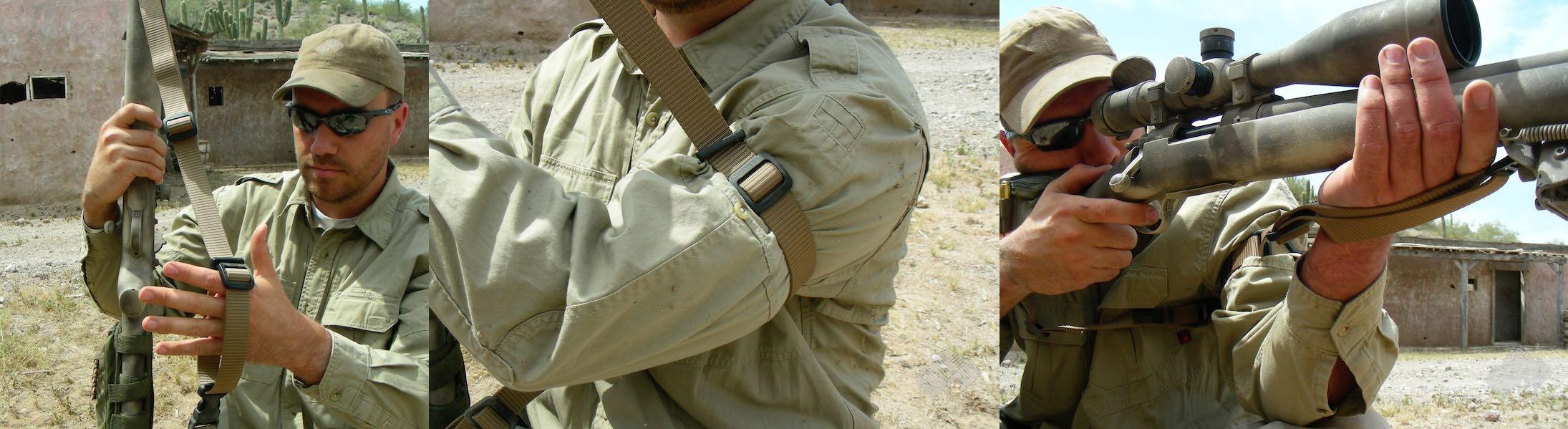
Using a purpose-built sling like the Wilderness Cleckner Cuff Sling,
the shooter threads his support arm through a loop built into the
sling’s strap. This loop is adjusted for length and diameter using two
tri-glide buckles. With the support arm threaded through the sling,
tension is created between the support arm and the barrel and stock.
This reduces muzzle sway and rise from recoil, and it provides a more
stable reticle and point of aim.
Making your own sling cuff

If you own a Multi-Mission Sling from Magpul,
then you already have what you need to create a stabilizing cuff so you
can improve your accuracy. The MS slings utilize tri-glide adjustment
buckles which, when sized correctly, allow for part of your sling’s
strap to function just like a traditional cuff sling.